Article Filtering
Sometimes you need to automatically tweak an incoming article, mark it as important, remove ads from its contents, or simply reject it. That is where the article-filtering feature comes in.
Article filters are meant for advanced users. They are powerful, but they can slow down feed updates, fetch extra data, launch external tools, or make changes that are synchronized back to some online services.
Article filters dialog
The dialog shown below lets you:
create, remove, enable, disable, and reorder filters
assign a filter to multiple feeds within the selected account
test a filter on already stored articles
run a filter on checked feeds and save the accepted changes back to the database
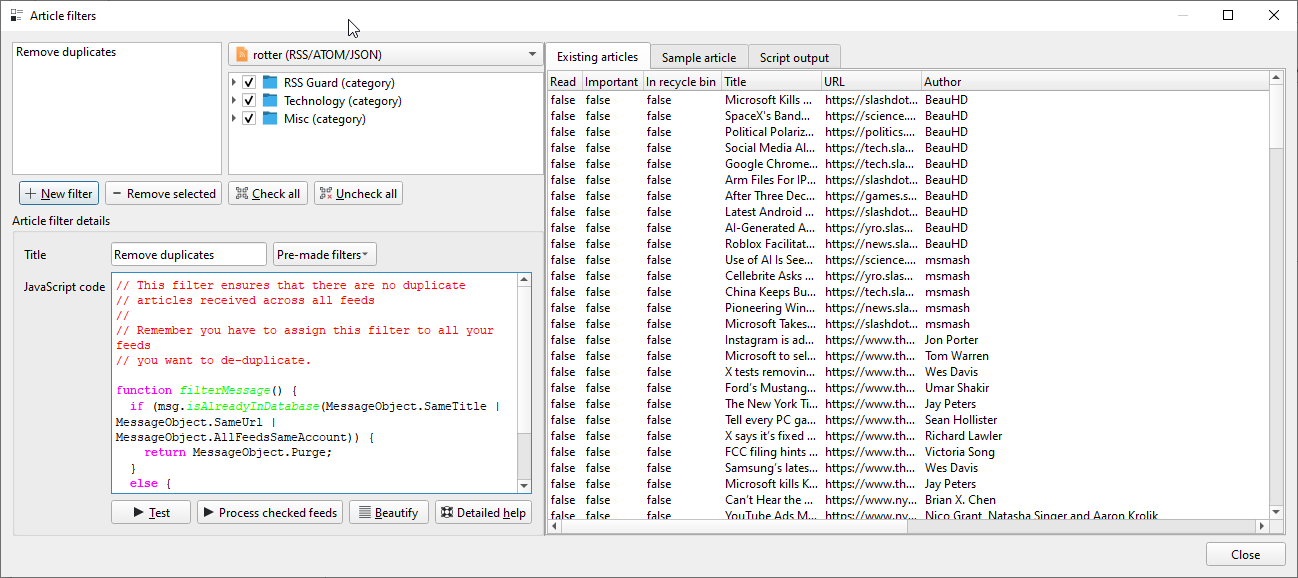
Filters run in ascending sort order. Only enabled filters are executed.
The right-hand side of the dialog has two main uses:
TestRuns the selected filter against the currently loaded existing articles without permanently saving any changes.Process checked feedsRuns the selected filter on undeleted articles from all checked feeds and writes accepted changes back to the database.
The Existing articles table is especially useful during testing:
Resultshows whether a message was accepted, ignored, or purgedchanged values in columns like
Read,Important,Trash,Title,Date, andScoreare highlightedtooltips show the original value and the filtered value
the lower detail tabs let you inspect article metadata and contents
The Script output tab shows messages written by app.log(...), and also shows script errors when testing from the dialog.
Warning
During normal feed fetching, a JavaScript error in a filter does not reject the article. RSS Guard logs the error and continues as if the message was accepted. In the testing dialog, the error is shown to you directly.
Warning
Feed-level article ignoring and article-count limits run after article filters. So even if your filter accepts an article, a later cleanup or ignore rule may still prevent it from being kept.
How filters are applied
Each enabled filter is run on each article in order.
For newly downloaded articles:
AcceptKeeps the article and continues to the next filter.IgnoreDrops the article from this fetch run. Later filters do not run for that article.PurgeBehaves likeIgnorefor a newly downloaded article.
For existing articles processed from the dialog:
AcceptKeeps the article and saves its changed fields.IgnoreSkips saving changes for that article.PurgePermanently removes the article from the database.
This means Ignore and Purge are very different when you run a filter on already stored messages.
Writing an article filter
Article filters are small JavaScript snippets. Each script must provide a function with this prototype:
function filterMessage() { }
The function must return one of the values from the FilteringAction enumeration.
The built-in JavaScript environment is based on Qt’s QJSEngine and includes a useful set of helper objects exposed by RSS Guard.
Each article is available via the global msg object. Other globals provide access to the current feed, account, helper functions, run metadata, application logging, and process launching.
Note
Some attributes such as read, unread, and starred states are synchronized back to your account’s server. So, for example, marking an article as important in a filter may trigger a matching state change on services that support it.
Attention
Special placeholders can be used in article filters. This is especially useful for loading helper files, keyword lists, or calling external tools from your user-data folder.
Power-user tips
Keep filters cheap first, expensive filters later. A fast duplicate or keyword check near the top can save time before you do heavier work like full-content extraction.
Prefer returning early. If a message should obviously be ignored, do that early and skip unnecessary processing.
Use
TestbeforeProcess checked feeds. This makes it much easier to catch a bad regular expression or an accidentalPurge.Use
app.log(...)while developing. It is much easier to debug a filter when it prints intermediate values into theScript outputtab.Be careful with
fetchFullContents(...). It may issue extra network requests, slow down updates, and substantially increase database size.Be careful with external executables. They can be extremely useful, but they can also be slow or platform-specific.
Global variables
These global objects are available to your scripts:
Global variable |
What it provides |
|---|---|
|
Information about the actual article being filtered or modified. |
|
Information about the feed the article belongs to. |
|
Account-related information. |
|
Application-wide helper functions such as logging and notifications. |
|
Utility functions for parsing data and reading or writing files. |
|
Information about the current filtering run. |
|
Process-launching helpers for calling external executables. |
Reference Documentation
Here is the complete reference documentation of the functions and properties available to your filtering scripts.
msg
Properties
Name |
Type |
Read-only |
Synchronized |
Description |
|---|---|---|---|---|
|
|
Yes |
Yes |
List of labels assigned to the article. |
|
|
Yes |
No |
List of categories of the article, extracted from the feed. |
|
|
Yes |
No |
List of attachments of the article. |
|
|
Yes |
No |
ID assigned to the message in the local RSS Guard database. |
|
|
No |
No |
ID of the message as provided by the remote service or feed file. |
|
|
No |
No |
The message title. |
|
|
No |
No |
The message URL. |
|
|
No |
No |
Author of the message. |
|
|
No |
No |
Contents of the message. |
|
|
No |
No |
Raw contents obtained from the remote service or feed. This is usually raw XML or JSON. It is normally useful only for newly fetched articles, not when testing existing ones from the dialog. |
|
|
No |
No |
Arbitrary number in the range <0.0, 100.0>. Useful for custom ranking and sorting. |
|
|
Yes |
No |
Returns |
|
|
No |
No |
Date and time of the message. |
|
|
No |
No |
Date and time when RSS Guard received this version of the message. |
|
|
Yes |
No |
Is |
|
|
No |
Yes |
Is the message read? |
|
|
No |
Yes |
Is the message important? |
|
|
No |
No |
Is the message placed in the recycle bin? |
Functions
Name(Parameters) |
Return value |
Description |
|---|---|---|
|
|
Adds a multimedia attachment to the article. |
|
|
Removes one enclosure from the article according to the index, starting from zero. |
|
|
Removes all enclosures from the article. |
|
|
Fetches fuller article contents for the article, in plain text or HTML form by using the article extractor. [1] |
|
|
Checks if a matching message is already stored in the database. |
|
|
Checks if a similar message is already stored in the database by using Jaro-Winkler similarity. |
|
|
Assigns a label to the message. The |
|
|
Removes a label from the message. The |
|
|
Removes all labels from the message. |
|
|
Creates RSS Guard labels for all categories of this message and can optionally assign them to the article. [2] |
app
Functions
Name(Parameters) |
Return value |
Description |
|---|---|---|
|
|
Prints a message to RSS Guard’s log and to the |
|
|
Displays a desktop notification with the given title and text. |
run
Properties
Name |
Type |
Read-only |
Description |
|---|---|---|---|
|
|
Yes |
Number of messages accepted so far in the current filtering run. |
|
|
Yes |
Zero-based index of the currently executing filter. |
|
|
Yes |
Total number of filters that will execute in the current run. |
acc
Properties
Name |
Type |
Read-only |
Description |
|---|---|---|---|
|
|
Yes |
Database ID of the account. |
|
|
Yes |
Title of the account. |
|
|
Yes |
List of labels currently available for assignment. |
Functions
Name(Parameters) |
Return value |
Description |
|---|---|---|
|
|
Finds a label with the given title. Returns the label ID or an empty string. |
|
|
Creates a label with the given title and color and returns the label ID. If the label already exists, its existing ID is returned. |
feed
Properties
Name |
Type |
Read-only |
Description |
|---|---|---|---|
|
|
Yes |
Custom ID of the feed. |
|
|
Yes |
Title of the feed. |
utils
Properties
Name |
Type |
Read-only |
Description |
|---|---|---|---|
|
|
Yes |
Name of your local machine. |
Functions
Name(Parameter) |
Return value |
Description |
|---|---|---|
|
|
Converts an XML string into JSON. |
|
|
Reads a file into a byte array. |
|
|
Writes a byte array to a file. |
|
|
Reads a text file as UTF-8. |
|
|
Writes text as UTF-8. |
|
|
Converts a textual date/time representation into a proper |
fs
Functions
Name(Parameter) |
Return value |
Description |
|---|---|---|
|
|
Launches an external executable with optional parameters and optional standard input, without waiting for it to finish. |
|
|
Launches an external executable, waits for it to finish, and returns its standard output as text. |
Warning
External processes launched through fs use the RSS Guard user-data folder as the default working directory unless you explicitly pass another one.
Examples
/*
 * Accept whitelisted articles based on regular-expression filtering.
 */
function filterMessage() {
  const whitelist = [
    /ubuntu.+desktop/i,
    /linux.+app/i,
    /\d.billion/i
  ];

  if (whitelist.some(re => re.test(msg.title))) {
    return Msg.Accept;
  }

  return Msg.Ignore;
}
/*
 * Mark matching articles as important and raise their score.
 */
function filterMessage() {
  if (/stock|crypto|market/i.test(msg.title)) {
    msg.isImportant = true;
    msg.score = 80;
  }

  return Msg.Accept;
}
/*
 * Skip likely duplicates by comparing title similarity.
 */
function filterMessage() {
  if (msg.isAlreadyInDatabaseWinkler(Msg.SameTitle, 0.05)) {
    return Msg.Ignore;
  }

  return Msg.Accept;
}
/*
 * Fetch fuller contents only for articles that seem new enough to keep.
 *
 * This uses RSS Guard's built-in article extractor automatically.
 */
function filterMessage() {
  if (!msg.isAlreadyInDatabase(Msg.SameCustomId | Msg.AllFeedsSameAccount)) {
    msg.fetchFullContents(false);
  }

  return Msg.Accept;
}
/*
 * Run RSS Guard's article extractor directly on HTML already stored in msg.contents.
 *
 * This is useful when the feed already carries HTML and you want readability cleanup
 * without downloading the article URL again.
 */
function filterMessage() {
  if (!msg.url || !msg.contents) {
    return Msg.Accept;
  }

  const extractor =
    "C:\\Path\\To\\rssguard-article-extractor.exe";

  const config = JSON.stringify({
    html: msg.contents
  });

  const extracted = fs.runExecutableGetOutput(
    extractor,
    [msg.url],
    config
  );

  if (extracted && extracted.trim()) {
    msg.contents = extracted.trim();
  }

  return Msg.Accept;
}
/*
 * Ignore articles older than 7 days.
 */
function filterMessage() {
  let now = new Date();
  let age = (now - msg.created) / (1000 * 60 * 60 * 24);

  if (age > 7) {
    return Msg.Ignore;
  }

  return Msg.Accept;
}
/*
 * Purge articles that were received by RSS Guard more than 2 days ago.
 * This differs from msg.created, which is the publication date from the feed.
 */
function filterMessage() {
  let now = new Date();
  let age = (now - msg.retrieved) / (1000 * 60 * 60 * 24);

  if (age > 2) {
    return Msg.Purge;
  }

  return Msg.Accept;
}
/*
 * Assign label "AI" to matching articles.
 * Make sure the label already exists.
 */
function filterMessage() {
  if (/AI|robot|software|hardware/i.test(msg.title)) {
    let id = acc.findLabel("AI");

    if (id) {
      msg.assignLabel(id);
    }
  }

  return Msg.Accept;
}
/*
 * Create labels automatically from message categories.
 */
function filterMessage() {
  msg.exportCategoriesToLabels(true);
  return Msg.Accept;
}
/*
 * Show a desktop notification only for apparently new breaking news.
 */
function filterMessage() {
  if (/breaking/i.test(msg.title) &&
      !msg.isAlreadyInDatabaseWinkler(Msg.SameTitle, 0.05)) {
    app.showNotification("Breaking News", msg.title);
    msg.isImportant = true;
  }

  return Msg.Accept;
}
/*
 * Turn the first enclosure into the main article URL.
 */
function filterMessage() {
  if (msg.enclosures.length > 0) {
    msg.url = msg.enclosures[0].url;
    msg.removeEnclosure(0);
  }

  return Msg.Accept;
}
/*
 * Use a keyword file from the user-data folder to assign a score.
 *
 * Each line should be:
 *   keyword,score
 */
function filterMessage() {
  let keywords = [];

  try {
    let fileContent = utils.readTextFile('%data%/keywords.txt');
    keywords = fileContent
      .split(/\r?\n/)
      .map(line => {
        let parts = line.split(',');
        if (parts.length === 2) {
          return { term: parts[0].trim(), score: Number(parts[1].trim()) };
        }
        return null;
      })
      .filter(k => k && !isNaN(k.score));
  } catch (e) {
    app.log('Keywords file missing -> default score 0.');
    msg.score = 0;
    return Msg.Accept;
  }

  let totalScore = 0;

  for (let k of keywords) {
    let re = new RegExp(k.term, 'i');
    if (re.test(msg.title) || re.test(msg.contents)) {
      totalScore += k.score;
    }
  }

  msg.score = Math.min(totalScore, 100);

  if (msg.score >= 70) {
    msg.isImportant = true;
  }

  return Msg.Accept;
}
/*
 * Keep a whitelist in an external text file.
 */
function filterMessage() {
  let keywords = [];

  try {
    let fileContent = utils.readTextFile('%data%\\whitelist.txt');
    keywords = fileContent.split(/\r?\n/).filter(line => line.trim() !== '');
  } catch (e) {
    app.log('No whitelist file found, accepting all articles.');
    return Msg.Accept;
  }

  for (let k of keywords) {
    let re = new RegExp(k, 'i');
    if (re.test(msg.title) || re.test(msg.contents)) {
      msg.isImportant = true;
      return Msg.Accept;
    }
  }

  return Msg.Ignore;
}
/*
 * Convert HTML article contents to plain text.
 */
function filterMessage() {
  let text = msg.contents;

  text = text.replace(
      /<a[^>]+href="([^"]+)"[^>]*>(.*?)<\/a>/gi, (m, url, label) => {
        return label + ' (' + url + ')';
      });

  text = text.replace(/<[^>]*>/g, '');
  text = text.replace(/\s+/g, ' ').trim();

  msg.contents = text;

  return Msg.Accept;
}
/*
 * Convert article contents from HTML to plain text with Pandoc.
 *
 * This uses a Pandoc binary placed directly in the user-data folder.
 */
function filterMessage() {
  let res = fs.runExecutableGetOutput(
      '%data%\\pandoc.exe',
      ['-f', 'html', '-t', 'plain'],
      msg.contents);

  msg.contents = res;

  return Msg.Accept;
}
/*
 * Parse raw XML and log one field while debugging.
 */
function filterMessage() {
  if (msg.rawContents) {
    let rawJson = utils.fromXmlToJson(msg.rawContents);
    app.log(rawJson);
  }

  return Msg.Accept;
}
/*
 * Raise the score for articles published on weekends.
 */
function filterMessage() {
  let day = msg.created.getDay(); // 0 = Sunday, 6 = Saturday

  if (day === 0 || day === 6) {
    msg.score = Math.min(msg.score + 15, 100);
  }

  return Msg.Accept;
}